
Why wellbeing support that starts at crisis point is already too late
· Camphy
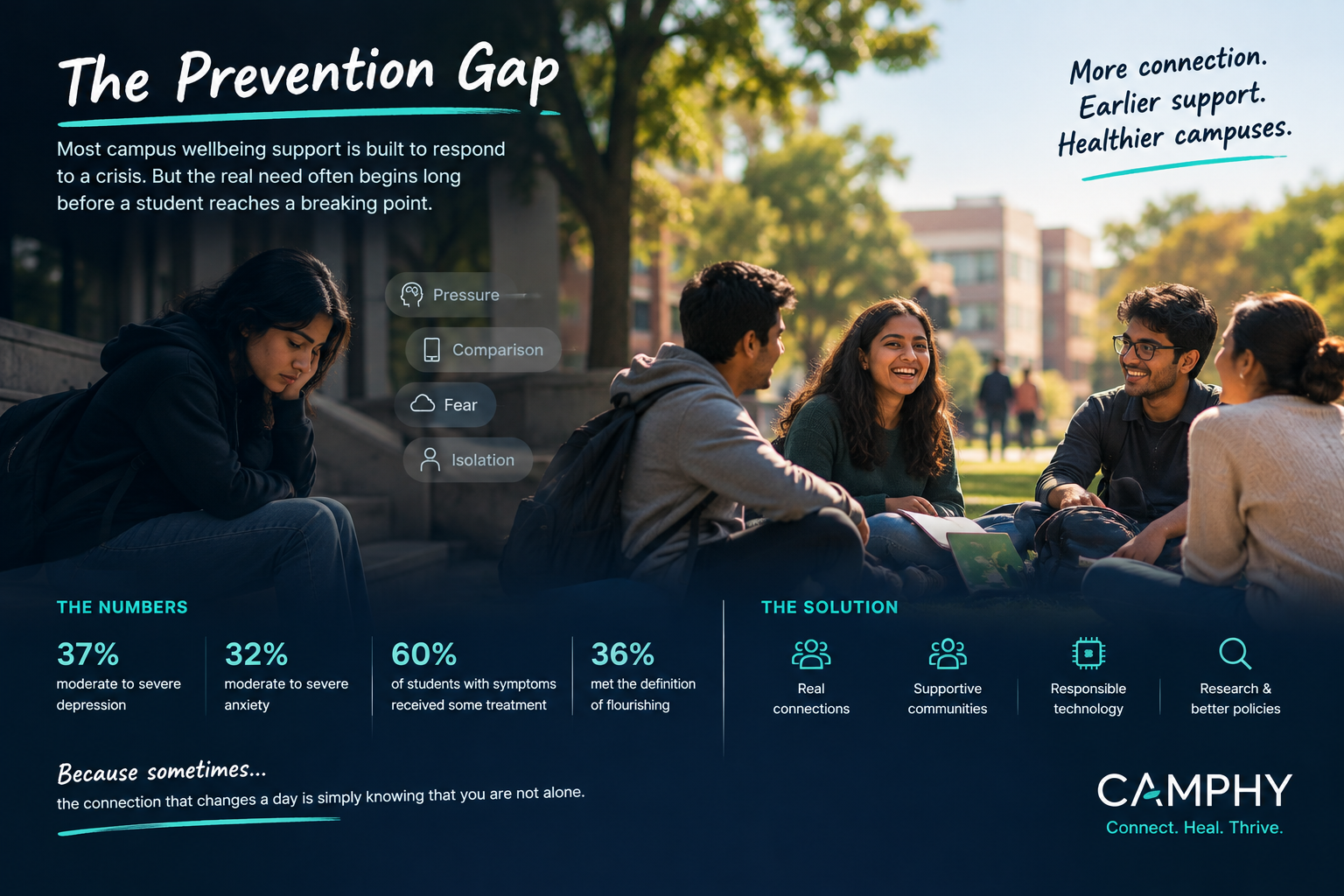
The prevention gap
Most campus wellbeing support is built to respond to a student who has already reached a breaking point, and the data suggest that is where the system is weakest. The most recent national Healthy Minds Study, covering more than 84,000 students at 135 institutions in 2024-25, found some real good news: severe depression fell from 23% in 2022 to 18%, and the share who had seriously considered suicide fell from 15% to 11%. Progress like that matters, and it is worth saying plainly.
But the same survey shows how much sits beneath the crisis line. Around 37% of students reported moderate to severe depression and 32% moderate to severe anxiety. About 60% of students with symptoms received some clinical treatment, which leaves a large group who did not, and the barriers they named were ordinary ones: lack of time (23%), cost (22%), and a preference for handling things with family or on their own (18%). None of these is a crisis. They are the everyday frictions that keep a struggling student from ever walking into a counselling office.
The survey also draws a distinction that crisis-first systems tend to miss. Symptoms fell, yet only 36% of students met the study's definition of flourishing. Being less unwell is not the same as being well. Loneliness is part of that picture: the U.S. Surgeon General's advisory reports that people who often feel lonely have more than double the odds of depression, and that lacking social connection is associated with a 26 to 29 percent higher risk of premature death. Long before anyone is in crisis, a student who eats alone, skips class because they know no one, and slowly stops trying is already on a path that a clinic cannot see.
Capacity realities in campus counselling
Counselling centres are not failing. They are doing a difficult job with limited room, and the numbers show what that room looks like. The Center for Collegiate Mental Health's 2024 annual report drew on 213 centres and 173,536 students who sought treatment. First screening appointments were typically reached in about 1.5 business days, and initial clinical evaluations in about 4.3, and roughly a third of students were seen on the same day they booked. Those are reasonable figures for a system under pressure. The report also notes that around 30% of the students it treated have a history of suicidal or self-injurious behaviour, which tells you where clinical time is going: to the students who are already at highest risk.
Staffing tells a similar story. The 2023-24 AUCCCD annual survey, reported by Inside Higher Ed, found that four-year institutions averaged 9.2 full-time-equivalent clinical staff, that about 11% of students at four-year colleges used counselling, and that only 24% of four-year centres said they had no trouble meeting demand. Twelve percent of non-trainee clinical positions turned over in a year, with low pay and working conditions cited most often. Demand has levelled off or dipped at many centres, but levelled off is not the same as met.
The practical point is that a counselling centre is designed as a treatment service, and treatment is scarce by nature. A centre that serves 11% of its students well cannot also be the main way the other 89% feel that someone notices them. CCMH's own recommendations focus on funding onsite treatment, psychiatric care and case management for high-risk students, and on working with deans, disability services and financial aid. That is the right ask of institutions. It also leaves a wide space upstream of the clinic that no counselling budget was ever meant to fill.
Peer and community layers
If the clinic is one layer, the question is what the other layers look like. The Jed Foundation's framework for campus mental health lists seven domains, and two of them sit well upstream of treatment: promoting connectedness and a positive campus culture, and reducing barriers to help-seeking. Counselling access is one item on that list, alongside life skills, recognising distress, and crisis systems. The premise is that wellbeing is produced by an environment, and a clinic is only one part of it.
Peer support is the layer students most often ask about, and the evidence is encouraging but not settled. A 2023 systematic review in BJPsych Open screened 12,763 records and included 28 papers. Peer learning and peer mentoring showed more positive results for anxiety and stress, while peer-led support groups gave mixed results. The authors were careful to say that most studies were of fair or poor quality and that differences in measurement prevented firm conclusions. So peer support is worth building, but nobody should claim it replaces professional care.
Community layers matter for a plainer reason. The Surgeon General's advisory found that time spent in person with friends fell from roughly 150 minutes a day in 2003 to about 40 minutes in 2020 among young people, and it calls on schools and communities to build the everyday structures, such as regular shared activities and places to gather, in which connection can happen. Students are the ones who fill those structures, and campuses have more of them than most students realise: clubs, study groups, faith and cultural societies, residence programmes, sports and volunteering.
A sensible way to picture the whole is as layers that hand people on to one another. Community catches the student who is lonely but coping. Peers notice the one who is struggling and can point toward help. Clinical services take those who need treatment. Crisis support sits at the end. The first layer is the one that is cheapest, earliest and least owned by anyone, which is why it is where the gap is widest.
What students can build themselves
Students cannot and should not be asked to run their own mental health system. What they can do is build the first layer, the one institutions are slowest to provide, and connect it to the layers above it.
Start with something regular and small. A weekly meal, a study session, a walk, or a standing game night gives a group a reason to see each other before anyone needs a reason. The value is in the repetition: people notice when a regular is missing, and that is often the earliest sign a peer network can pick up. Keep the group open enough that a newcomer can join without an introduction.
Second, make asking easier. The Healthy Minds barriers were time, money and a habit of managing alone. Friends can quietly lower each of them: offering to go along to a first appointment, sharing what they found out about how the campus service works and what it costs, and treating a request for help as ordinary. A student who has heard a friend say "I went, it was fine" is far more likely to go.
Third, learn what your campus already offers before you need it. Many institutions run peer mentoring, peer-led groups, student wellbeing societies and low-cost or free counselling, and few students can name more than one. If you lead a club or a hall, put a short list of those options where members will see it.
Finally, know the limit of the role. A friend can listen, stay in touch and help someone reach support, but a friend is not a therapist. If someone talks about wanting to die or seems to be in immediate danger, contact your campus emergency line or your local crisis service and stay with them if you can. That is not a failure of friendship. It is what the other layers exist for.
Campus wellbeing works when a student is known by at least a few people, when help is easy to find, and when clinical care is kept for those who need it. Building the first of those is the part students can start this week.
Sources
- Healthy Minds Study 2024-25 findings, University of Michigan School of Public Health
- Center for Collegiate Mental Health, 2024 Annual Report
- AUCCCD annual survey coverage, Inside Higher Ed, March 2025
- U.S. Surgeon General's Advisory on loneliness and isolation, 2023
- Pointon-Haas et al., peer support systematic review, BJPsych Open
- The Jed Foundation, our approach