
Why We Built Camphy Around Intent Instead of Profiles
· Camphy
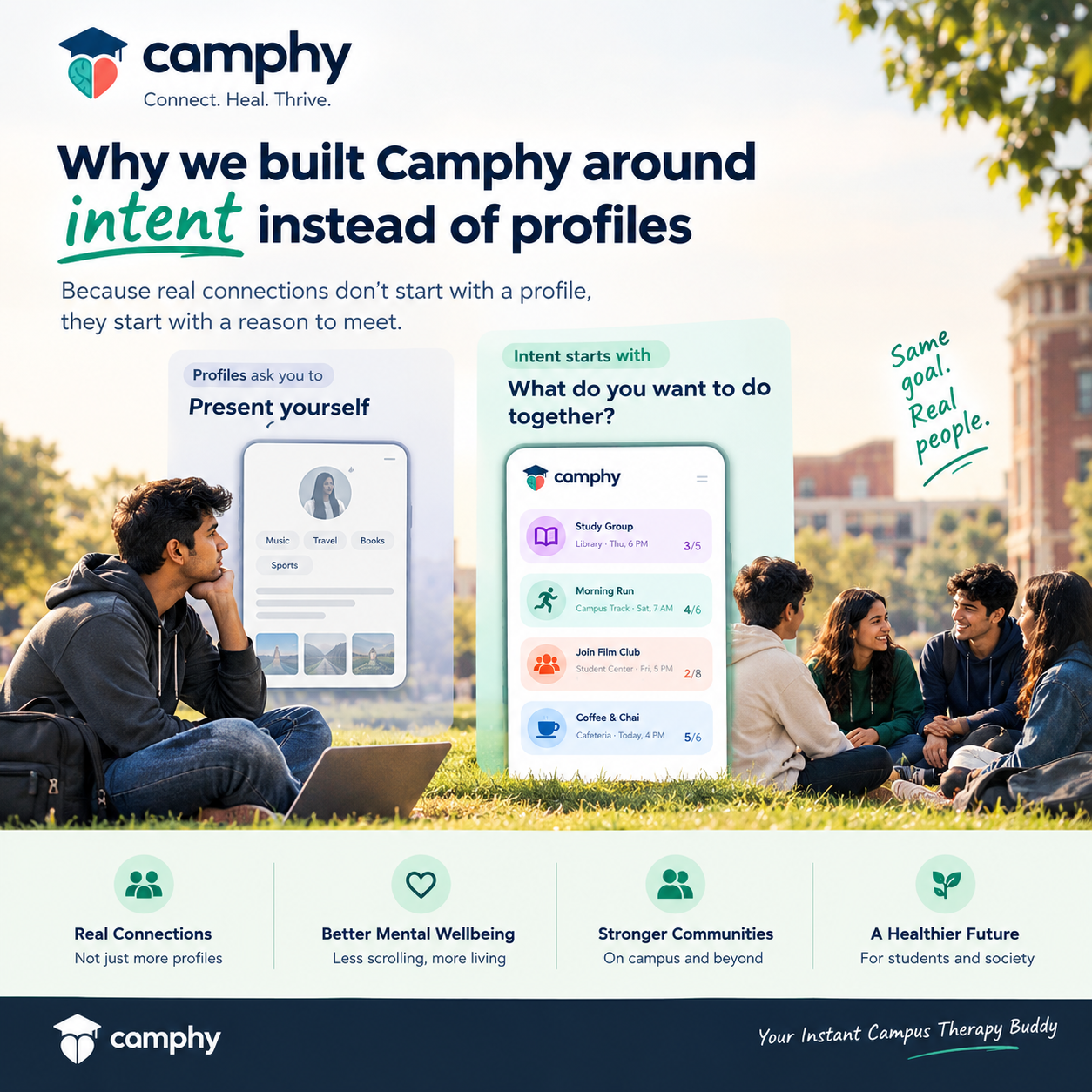
Most social products begin with a profile.
A photo. A bio. A list of interests. Maybe a few posts.
It makes sense. A profile seems like the natural way to introduce yourself to strangers.
But the more we thought about loneliness and the difficulty of making meaningful connections, the more we questioned that assumption.
What if the first thing people need is not to present themselves, but a reason to connect?
That question shaped Camphy.
What profiles reward
Profiles reward presentation.
They encourage us to think about how we look, what we should write, which interests make us interesting, and how others might perceive us.
That can work when someone is already confident and actively looking to socialize. But for someone who feels isolated, approaching people can already feel difficult. Asking them to first create a polished version of themselves can add another barrier.
Research gives us some reason to think carefully about this design.
A major review of online dating by Eli Finkel and colleagues found that browsing and comparing large numbers of profiles can encourage people to treat potential partners as items to compare. The review also found little evidence that matching algorithms could reliably predict interpersonal chemistry.
That research is about dating, not friendship or student communities, and it is from 2012. We should not stretch its conclusions beyond what the evidence supports.
But the underlying question remains relevant:
When we turn people into profiles, do we make connection easieror do we make people easier to compare?
The U.S. Surgeon General's 2023 advisory on social media and youth mental health makes a similarly important distinction. Social media can help young people find connection and acceptance, but the evidence around which specific features create harm or benefit remains incomplete.
For us, that uncertainty is important.
We don't want to build another product that simply keeps people looking at other people's lives.
We want to make it easier for people to actually meet.
What intent changes
By intent, we mean what someone wants to do with another person right now.
Study together on Thursday.
Find someone for a morning run.
Try a club meeting without going alone.
Grab coffee between classes.
Attend an event with someone instead of walking in alone.
The starting point becomes the activity, not the profile.
That distinction matters because friendships are built through shared time.
Jeffrey Hall's research on friendship found that moving from acquaintance toward friendship takes substantial time together. Shared activities create opportunities for that time to happen naturally.
An intent gives two people something simple to begin with.
You don't have to think:
"What should I message this person?"
You can simply think:
"We both want to do this. Let's start there."
There is another reason we believe this matters.
Research on the liking gap has found that people often underestimate how much a new conversation partner likes them after an interaction.
That first interaction can therefore feel more intimidating than it actually is.
An activity can take some pressure away.
If two people meet for a walk or a study session, the entire interaction doesn't depend on whether they immediately become best friends. They have something to do, something to talk about, and an opportunity to meet again.
And intent can make expectations clearer.
“I’m looking for people to run with every Sunday” is different from simply appearing on someone's feed.
It tells people what you are looking for.
They can say yes.
They can say no.
And nobody has to guess what the invitation means.
What it costs us
We also don't want to pretend that an intent-first approach has no trade-offs.
There is less to endlessly browse.
That is intentional.
Profile-based social products can make discovery feel effortless: scroll, compare, swipe and continue.
We are choosing a different experience.
Sometimes that means discovery is slower. Sometimes an intent may not receive an immediate response. And sometimes the person you meet through an activity may not become a friend.
That's part of the uncertainty.
There is another limitation we cannot solve with technology.
Some of the best friendships begin without an intention at all in a corridor, a classroom, a queue, a shared joke or a completely unexpected conversation.
No platform can manufacture those moments.
What we can do is make the intentional part of connection easier.
Create a reason to take the first step.
What we are still unsure about
We don't know yet whether intent-first products create better friendships than profile-first products.
And we don't want to pretend that the research proves that they do.
The evidence we have is indirect. It tells us about how people compare profiles, how conversations develop, and how friendships grow through shared time. It does not prove that Camphy's approach will produce a particular outcome.
So this is a conviction, not a conclusion.
We believe starting with “What do you want to do together?” can be a better starting point for human connection than “How do you want to present yourself?”
But the only honest way to test that belief is to keep listening.
To students.
To working professionals.
To people who have tried existing social platforms and found them exhausting.
And especially to the people who still haven't found the connection they were looking for.
That feedback should shape what we build next.
Because Camphy isn't trying to build another place where people simply see more people.
We are trying to make it easier for people to find a reason to meet.
If you've ever felt that profile-based social platforms make connection feel more complicated than it should, I'd genuinely like to hear your experience.
Connect. Heal. Thrive.
Sunil Singhanad
Founder, Camphy
www.camphy.in
Sources
- Finkel, E. J., Eastwick, P. W., Karney, B. R., Reis, H. T., & Sprecher, S. (2012). Online Dating: A Critical Analysis From the Perspective of Psychological Science.
- U.S. Surgeon General (2023). Social Media and Youth Mental Health: The U.S. Surgeon General's Advisory.
- Hall, J. A. (2018). How many hours does it take to make a friend? University of Kansas.
- British Psychological Society Research Digest. The Liking Gap.