
Why the best campus friendships start with a shared activity, not a conversation
· Camphy
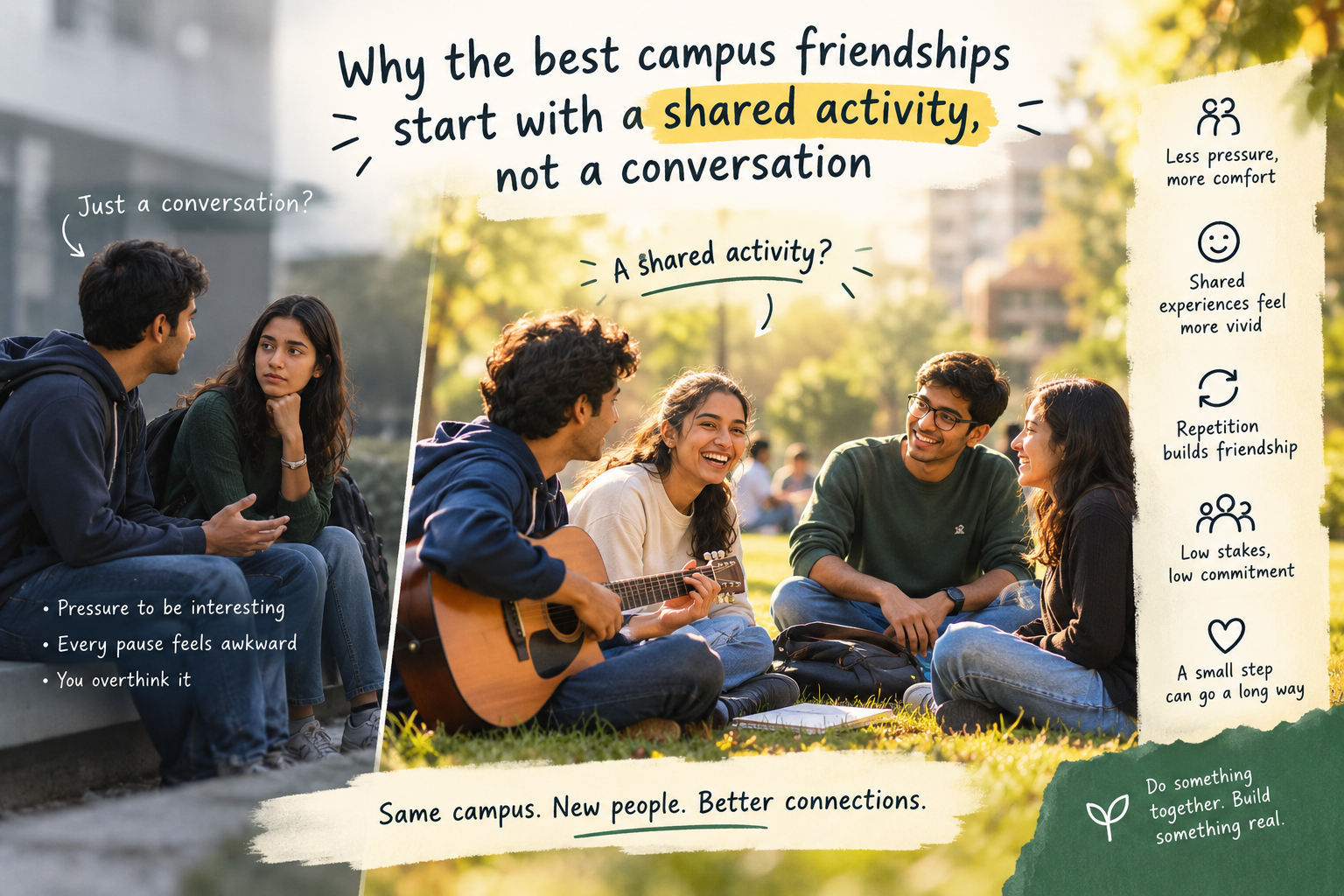
Side-by-side versus face-to-face
Meeting a stranger by sitting down and talking puts all the weight on the conversation. Every pause is visible, every sentence has to be interesting, and each person is quietly grading themselves. It is a demanding format, and it is the one most students are told to use.
It also rests on a mistaken belief. Erica Boothby and colleagues found in their well-known liking gap studies that people consistently underestimate how much a new conversation partner liked them. The gap held whether a conversation lasted 2 minutes or 45, and among first-year students at Yale living in dormitory suites it persisted for most of the semester. In other words, the private verdict you deliver on yourself after an awkward chat is usually harsher than the one the other person reached.
Doing something side by side changes the arrangement. Attention is shared between two people and a task, so conversation can start, stop and wander without feeling like a failure. Silence is allowed because there is something else to look at. There is also some evidence that a shared experience simply feels more vivid. In a 2014 study in Psychological Science, described by ScienceDaily, strangers who tasted chocolate together in silence rated pleasant flavours as more pleasant and unpleasant ones as more unpleasant than those who tasted alone.
A caution about what we can claim. There is little research that directly compares side-by-side and face-to-face meetings as routes to friendship, and the studies above were small and used student volunteers. What they show is a consistent pattern: conversation is harder and goes better than we expect, and shared attention is a low-cost way to feel connected. It is a reasoned case for shared activity, not a proven rule.
Low-stakes contexts
Not every activity works. The ones that do share a few features: they repeat, they cost little to attend, they let you leave without explanation, and they give your hands or eyes something to do. A climbing session, an intramural team, a cooking club, a volunteering shift, a choir rehearsal, a running group, a board-game evening and a campus radio show all fit. A one-off lecture or a networking mixer does not, because there is no reason for the same people to meet twice.
Repetition matters most. Jeffrey Hall's 2018 study of new movers and University of Kansas freshmen, published in the Journal of Social and Personal Relationships, estimated that about 50 hours together turns an acquaintance into a casual friend. Hall also noted that time spent hanging out and joking around counted for more than time spent working together. So choose contexts with some play in them, or at least gaps for chat, such as the warm-up before a rehearsal or the walk back from a match. A group that only works in silence will keep you busy without making you friends.
Low stakes also means low commitment. You should be able to try a session, not enjoy it, and go home without having said anything you now need to take back. Start with one or two contexts you would enjoy even if you made no friends there. That keeps the pressure down, and it means the time is well spent whatever happens.
It is also worth choosing things that fit your life. The Surgeon General's advisory found that young people's in-person time with friends fell from roughly 150 minutes a day in 2003 to about 40 in 2020. A weekly slot you can actually keep will do more than an ambitious schedule you abandon.
Converting an activity into a friendship
An activity gives you regular contact, but it does not turn acquaintances into friends by itself. Somebody has to take a small step beyond it. The same research that finds a liking gap suggests what that step should feel like. Boothby, quoted in the World Economic Forum's summary of a 2023 follow-up on teams, recommends recognising that the gap exists, taking the initiative, and telling people when you enjoyed their company. If the other person probably likes you more than you think, then asking them for something small is a better bet than it feels.
In practice, the steps are modest. Stay a few minutes after the session and chat while people pack up. Send a short message between meetings about something specific, such as "that last piece was harder than it looked." Suggest a small extension of the activity: coffee after training, lunch before the rehearsal, a walk to the next class. Say plainly that you enjoyed their company, because most people rarely hear it.
Hall's numbers show why the extension matters. Moving from casual friend to friend takes roughly another 90 hours, and much of that has to come from unstructured time that the activity alone does not supply. Each small extension adds a few of those hours.
And keep the activity as the anchor. Friendships that begin around something have a natural reason to continue and an easy way back if you drift apart. If one person becomes a good friend, invite them into a second setting, but do not abandon the first. It is the reason you met, and it keeps the meetings regular when the semester gets busy.
Sources
- The Liking Gap studies, British Psychological Society Research Digest, summarising Boothby et al., Psychological Science, 2018
- Sharing makes both good, bad experiences more intense, ScienceDaily, on Boothby, Clark and Bargh, Psychological Science, 2014
- Hall, How many hours does it take to make a friend? University of Kansas summary, 2018
- The liking gap in workplace groups, World Economic Forum, February 2023
- U.S. Surgeon General's Advisory on loneliness and isolation, 2023