
What a Year of Building a Social Connection Product Taught Us About Loneliness
· Camphy
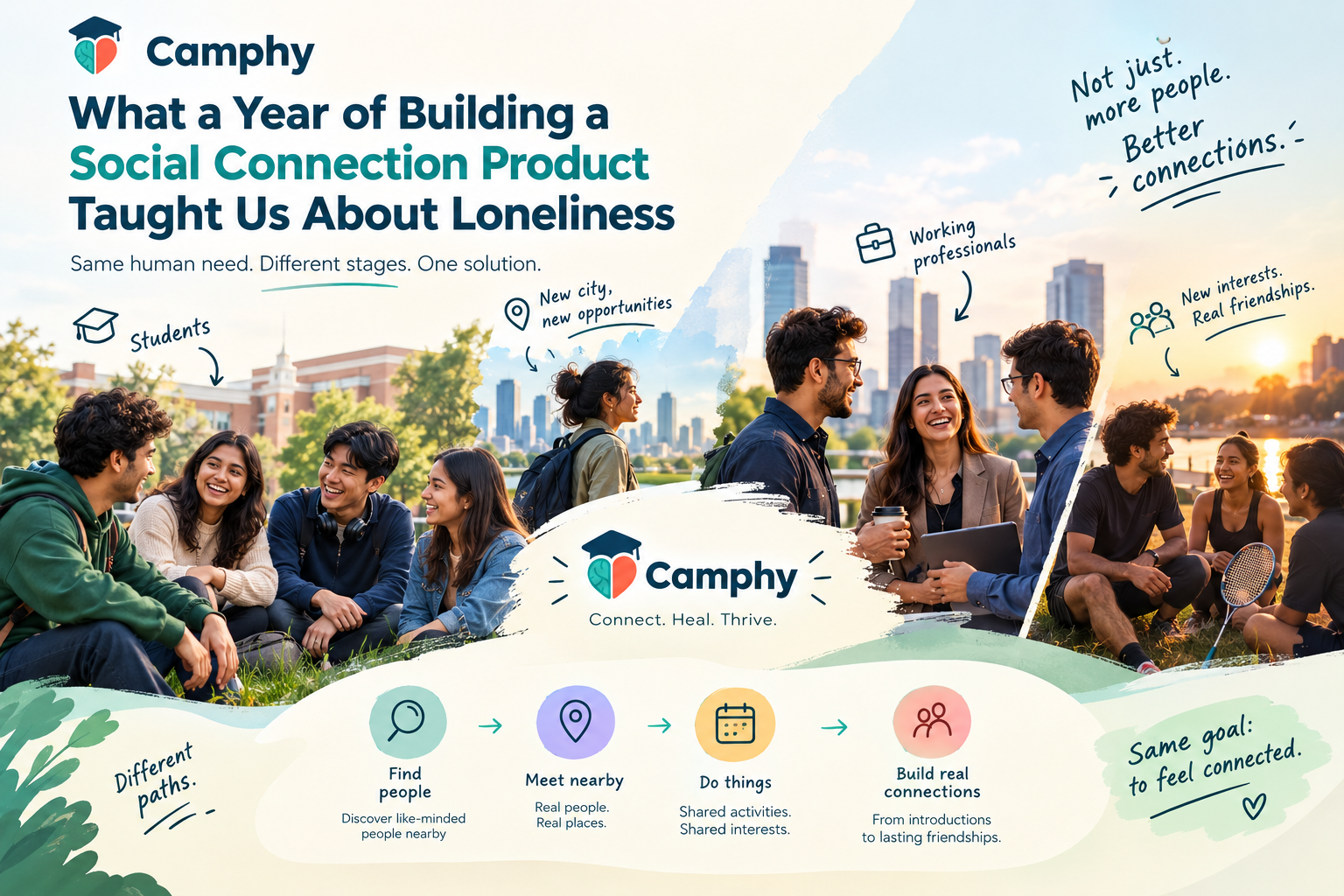
When we started building Camphy, we had a simple assumption: if people feel lonely or disconnected, perhaps the problem is that they do not have enough opportunities to meet the right people.
It sounded intuitive.
Students arrive at a new campus and do not know many people. Young professionals move to a new city for work and leave familiar communities behind. People change jobs, relocate, graduate, or simply grow apart from old friends.
In each situation, there can be plenty of people around and still be very little meaningful connection.
A year of building Camphy has made us rethink what the real problem is.
The challenge is not simply finding people.
It is finding the right opportunity, context and comfort to connect with them.
And that distinction matters.
Loneliness Is Not About Being Alone
Loneliness is often described as being alone, but that definition is too simple.
Someone can live alone and feel perfectly connected. Someone else can sit in a crowded classroom, a busy office or a shared apartment and still feel isolated.
Loneliness is closer to the gap between the relationships and connection a person wants and what they actually experience.
Research increasingly reflects this complexity. A 2026 analysis of the National College Health Assessment found that 88.3% of students reported a sense of belonging, while 50.8% reported feeling lonely.
Both experiences can exist at the same time.
That observation changed how we thought about Camphy.
We stopped looking at loneliness as a problem belonging only to a particular category of people.
It can affect a student entering university.
It can affect a professional moving to a new city.
It can affect someone starting their first job.
It can affect someone working remotely.
It can affect someone who has hundreds of online connections but very few people they can actually meet for a walk, a game, a meal or a conversation.
The common thread is not age or occupation.
It is disconnection from meaningful human relationships.
What We Observed While Building
As we moved from an idea toward a real product, three observations became increasingly important.
1. Life transitions create connection gaps
Students and working professionals experience different environments, but many of their social challenges are surprisingly similar.
A student may enter a campus where almost everyone is new.
A young professional may move from a familiar hometown to a city where they know nobody.
A working professional may spend most of their week around colleagues but still lack friendships outside work.
The context changes. The underlying need does not.
Transitions disrupt existing social routines.
The people you used to meet regularly may no longer be nearby. The places where you naturally met people may disappear. And suddenly, building a new social circle requires intentional effort.
That is harder than it sounds.
People are generally comfortable meeting others when there is a natural reason to do so.
A class provides a reason.
A sports activity provides a reason.
A shared hobby provides a reason.
A workplace provides a reason.
But simply telling someone to "make new friends" provides almost no context at all.
This is one reason we became interested in shared interests and activities as a bridge to human connection.
Instead of starting with:
"Would you like to be my friend?"
the interaction can start with:
"Do you want to play badminton?"
"Are you interested in startups?"
"Want to explore this place together?"
The second feels much more natural.
2. The first connection is only the beginning
One of our early lessons was that discovery alone does not create relationships.
A platform can introduce two people.
That does not mean they will become friends.
The more important questions come afterwards:
Will they actually meet?
Will they have something to do together?
Will the interaction feel comfortable?
Will they meet again?
Can a one-time interaction become a recurring relationship?
Research by Jeffrey Hall estimated that moving from acquaintance toward friendship can require substantial time spent together.
That is an important lesson for anyone building a social product.
The goal should not simply be to maximise introductions.
It should be to make it easier for people to keep showing up.
For Camphy, this is why we think beyond digital discovery.
Our focus is on creating pathways from online discovery to offline interaction - helping people find relevant people nearby and giving them natural reasons to meet.
We call this approach Peer-to-Near, Face-to-Face.
3. Loneliness is often invisible
Another lesson is that people who are disconnected do not always look disconnected.
A student may be active in class, participate in events and post regularly on social media.
A professional may have a busy calendar, a large workplace network and hundreds of LinkedIn connections.
None of those things necessarily means they have someone they feel genuinely comfortable meeting outside those contexts.
Research also shows that loneliness can affect different groups differently. A Gallup analysis of 2023 and 2024 data, for example, found particularly high levels of reported loneliness among younger men in the United States.
For us, this reinforces a simple principle:
People should not have to identify themselves as "lonely" before they can look for connection.
The language of loneliness can feel heavy.
The language of interests, activities and community feels much more natural.
Someone may never say:
"I am lonely."
But they might say:
"I just moved here."
"I want to meet people who play badminton."
"I am looking for people interested in startups."
"I want to explore the city."
"I don't know many people around here."
Those statements can lead to the same underlying need: connection.
What We Got Wrong
Building a social product has also taught us that the problem is much more nuanced than we initially imagined.
One of our biggest lessons has been that creating opportunities to connect is not the same as creating meaningful connection.
It is relatively easy to build profiles, discovery features, interest tags and messaging.
The harder part is reducing the social friction between two strangers.
People often hesitate before approaching someone they do not know.
They wonder:
Will this be awkward?
Does the other person actually want to meet?
What will we talk about?
Is it safe?
Do we have anything in common?
These questions exist for students and professionals alike.
This changed our thinking about product design.
We became less interested in building another platform where people endlessly browse profiles and more interested in creating context around connection.
A shared interest can create context.
A nearby activity can create context.
A verified community can create context.
A simple invitation can create context.
The technology matters, but the human situation matters more.
Students and Professionals Are Not the Same - But They Share a Need
We do not want to pretend that students and working professionals have identical social lives.
They do not.
Students may be navigating a new campus, academic pressure, hostel life and changing peer groups.
Working professionals may be dealing with relocation, long working hours, remote work, urban isolation or social circles that become increasingly difficult to maintain.
But both can face the same underlying question:
"Who can I connect with around me?"
That is where we believe there is an opportunity to build something broader than a campus-only network.
Camphy began with strong roots in student communities, but the problem we are exploring extends beyond universities.
It exists wherever people are trying to build a social life in a changing environment.
That could be a university campus.
A new workplace.
A metropolitan neighbourhood.
A residential community.
A new city.
Or simply a stage of life where old routines no longer provide the same sense of connection.
What We Would Tell Someone Building in This Space
If someone asked us what we have learned after a year of building, we would offer four principles.
1. Do not mistake contact for connection
More matches, messages or followers do not automatically mean stronger relationships.
The U.S. Surgeon General's advisory on loneliness and social connection highlights the decline in young people's in-person time with friends over the past two decades.
The answer is not simply more digital interaction.
People need relationships in which they feel known, valued and comfortable being themselves.
2. Design for the second and third interaction
The first meeting gets most of the attention.
We think the second and third meetings may matter more.
Friendships develop through repeated shared experiences.
A social product should therefore think beyond discovery:
How do we help people come back?
How do we help them find another activity?
How do we make it natural to meet again?
How do we turn an introduction into familiarity?
Those questions are much harder than building a matching feature, but they are also much closer to the real problem.
3. Build around human behaviour, not just technology
It is tempting to believe that better algorithms automatically create better social outcomes.
They do not.
Technology can help identify common interests, proximity and potential compatibility.
But people still need trust, context, timing and a reason to interact.
The product should therefore reduce friction without trying to engineer friendship itself.
Friendship cannot be automated.
The conditions for friendship can be made easier.
4. Listen to the people who do not use your product
This may be the most important lesson.
The people who use a product tell you what is working.
The people who do not use it can tell you what is missing.
Some people may not consider themselves lonely.
Some may already have a social circle.
Some may not trust a new platform.
Some may not feel comfortable approaching strangers.
Some may simply not see a compelling reason to participate.
These are not necessarily marketing problems.
They can be product insights.
For us, this means continuing to listen to students and working professionals - including the people who are curious about Camphy but have not yet found a reason to use it.
What Building Camphy Changed for Us
When we started, we thought the problem was relatively straightforward:
People need more opportunities to meet others.
Today, we would describe it differently.
People need better opportunities to form meaningful connections in the context of their real lives.
That might mean helping a student find someone with a shared interest on campus.
It might mean helping a professional who has recently moved to a city discover people nearby.
It might mean finding someone to play a sport with.
It might mean joining a local community.
Or it might simply mean making the first interaction with a stranger feel a little less strange.
This is why we do not see Camphy as another platform designed to maximise screen-based social interaction.
We see technology as an infrastructure layer for human reconnection.
The objective is not to keep people online for longer.
It is to help people move from digital discovery toward real-world participation.
From a profile to a person.
From an introduction to an interaction.
From an interaction to familiarity.
And, hopefully, from familiarity to friendship.
A year of building has taught us that loneliness is not simply the absence of people.
Sometimes, it is the absence of the right context in which people can connect.
That is the problem we want to keep working on.
Not just for students.
Not just for professionals.
But for anyone who wants to feel a little more connected to the people and communities around them.
Because technology should not replace human connection. It should make human connection easier to happen.
Sources
- Reeves-Doyle, Sanyaolu and Scott-Hillis Geller, Student Organization Involvement and Mental Health, Frontiers in Education, 2026.
- Ohio State University, Student Loneliness at Ohio State, May 2025.
- Healthy Minds Study 2024–25 findings, University of Michigan School of Public Health.
- Gallup, Younger Men in the U.S. Among the Loneliest in West, 2025.
- U.S. Surgeon General, Our Epidemic of Loneliness and Isolation, 2023.
- Jeffrey Hall, How Many Hours Does It Take to Make a Friend?, University of Kansas, 2018.