
How to start something on campus when you know nobody
· Camphy
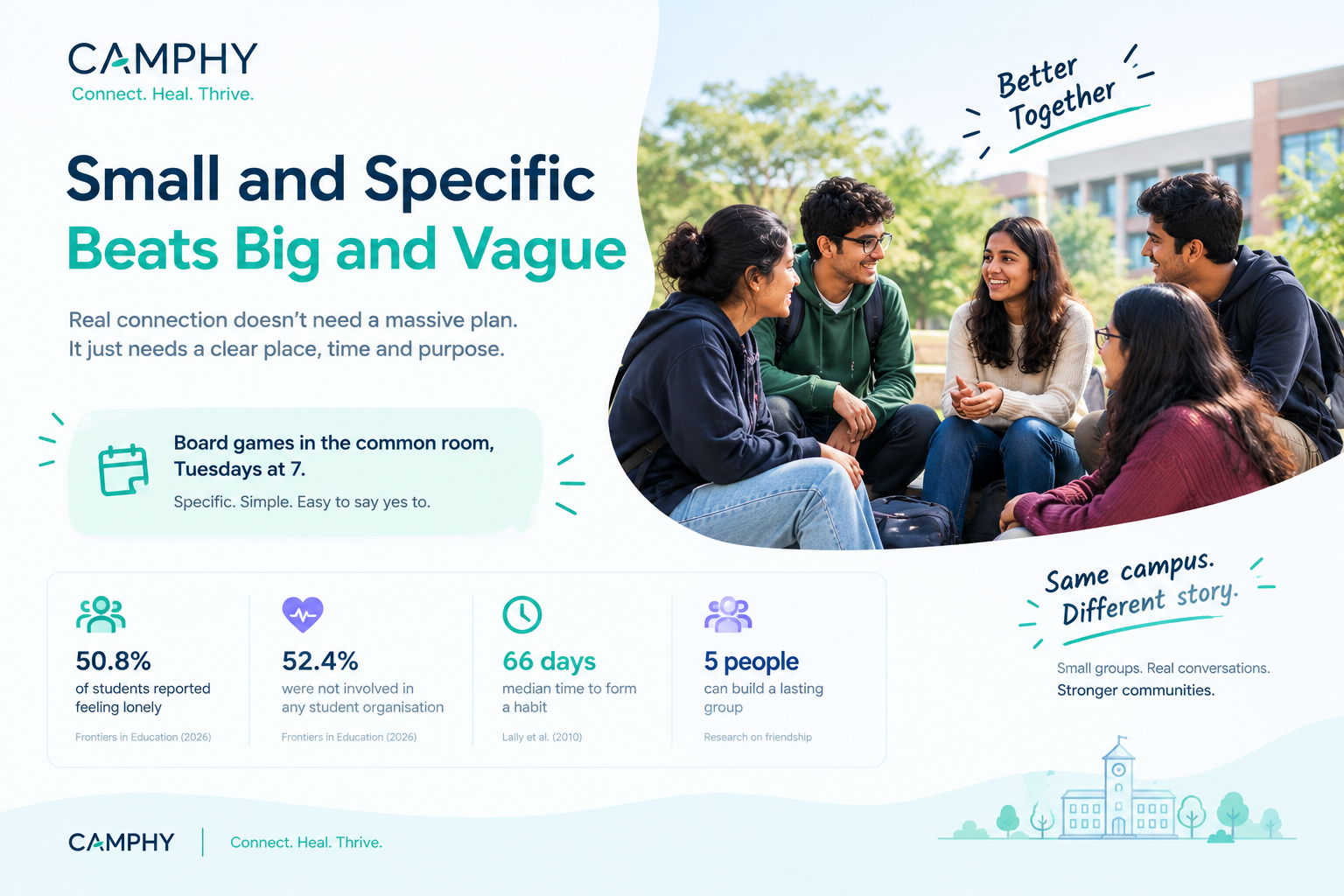
Small and specific beats big and vague
The usual advice for a lonely new student is to put yourself out there, and it fails because it names no place to stand. A club for everyone who wants to meet people is a vague promise, and vague promises are easy to ignore. A Thursday walk at 6pm from the library steps, for anyone who wants to talk about film, is small and specific. A stranger can picture it, decide within seconds whether it is for them, and say yes without much risk.
The scale of the need is real. A 2026 study in Frontiers in Education using the National College Health Assessment, with 78,024 students from 125 institutions, found that 50.8% reported feeling lonely and that 52.4% were not involved in any student organisation. Ohio State's 2025 loneliness report found 43.2% of the students it screened were lonely. Whatever you start, most of the people around you are looking for a place to belong just as you are.
The same Frontiers study adds an honest caution. Belonging rose with involvement and then levelled off, loneliness fell only modestly, and the correlations were weak. Joining or starting something helps, but it is not a cure, and more is not better. That is an argument for one small thing done well rather than five ambitious ones.
So begin with a single sentence that has an activity, a time and a place in it. "Board games in the common room, Tuesdays at 7" works. "A community for gamers" does not. If you cannot say what happens at the first meeting, the idea is still too big.
The first five people
You do not need a crowd. You need about five people who come back. Research by Jeffrey Hall, published in the Journal of Social and Personal Relationships in 2018, followed 355 adults who had recently moved and 112 first-year students at the University of Kansas over seven weeks. It found that it takes roughly 50 hours together to move from acquaintance to casual friend, about 90 to become a friend, and more than 200 for a close friend. Time spent hanging out and joking around counted for more than time spent working together.
The implication is that a friendship is mostly a matter of accumulated shared hours, and a small group that meets weekly is a machine for producing them. Five people meeting for two hours every week will pass the casual-friend line together in about ten weeks, which is roughly a semester.
Finding those five is a personal task, not a broadcasting one. Posting once in a large group chat tends to bring silence. Instead, invite people directly: someone from your seminar who laughed at the same thing you did, a hallmate you have nodded to twice, the person who reacted to your post. Ask eight or ten people in a friendly, low-pressure way and expect three to five to turn up. Say exactly what it is and how long it lasts, so that coming feels cheap: "an hour, no prep, come for as long as you like."
When someone does come, make the second meeting easy. Ask what they would like to do next time, and use their idea. A person who has shaped the thing has a reason to return, and a group that two or three people feel they own is much more durable than one that a single person is running for everyone else.
Consistency over ambition
Most campus projects die of ambition, not neglect. A student plans a big launch, a poster campaign and a guest speaker, spends two weeks on it, and then feels too tired to run the second event. The alternative is to make the thing so plain that running it takes almost no effort: the same day, the same time, the same place, no preparation.
The best-known research on how repeated behaviour becomes automatic is by Phillippa Lally and colleagues, who followed 96 university volunteers as they built a new daily habit. As summarised here, the median time to reach a plateau of automaticity was 66 days, but individual estimates ran from 18 to 254 days. Importantly, one missed day did not materially disrupt the process. The authors also note that fewer than half of participants met the criteria for modelling, so treat the figures as a guide rather than a law.
For a campus group, the lessons are practical. Expect it to take longer than you think before the meeting feels normal, and do not read a slow start as a sign that it has failed. Do not cancel because only two people are coming. Two people who have a good time are the start of a group, and a cancelled meeting teaches everyone that it is optional. And if you miss a week for an exam, say so and name the next date, then carry on.
Consistency also protects you. Because the format is fixed, you never have to decide again whether to run it, which is the decision that people are most likely to talk themselves out of when they are busy or low. Ambition can come later, once the habit is there to carry it.
Surviving the third week
The third week is when most new groups wobble. The novelty has worn off, the first assignments are due, and the person who came out of curiosity now has to choose to come out of habit. Attendance dips, and the organiser takes the dip personally.
It helps to know that this is normal, and that the stakes are higher than they look. Ohio State's Longitudinal Residential Experience Study, which used daily diaries from first-year students in 2024-25, found that loneliness at the start of a semester predicted loneliness at the middle of it, while an early sense of community predicted less loneliness later. What you build in the first weeks tends to carry the rest of the term, so a wobble is worth working through.
A few habits make it survivable. End each meeting by asking who is in next week, out loud, so that each person has made a small commitment. Send a short message the day before with the time and place, and keep it warm rather than pleading. Share the running of the group with one other person, so that it does not depend on your energy alone. If a slot clearly is not working, change the time before you change the idea, because an awkward hour is a far more common cause of a thin turnout than a bad concept.
And decide beforehand what counts as success. If two people came and had a good hour, the third week went well. Set that bar in advance and you will not be tempted to quit at the first empty chair.
If a group truly fades, that is not proof you cannot build community. You now know the people who did come, and you can ask them what they would keep. Starting again with a slightly different shape is how most lasting groups began.
Sources
- Reeves-Doyle, Sanyaolu and Scott-Hillis Geller, student organization involvement and mental health, Frontiers in Education, 2026
- Ohio State University, Student Loneliness report, May 2025
- Hall, How many hours does it take to make a friend? University of Kansas summary, 2018
- Lally et al., How are habits formed, European Journal of Social Psychology, 2010, as summarised by The Behavioral Scientist