
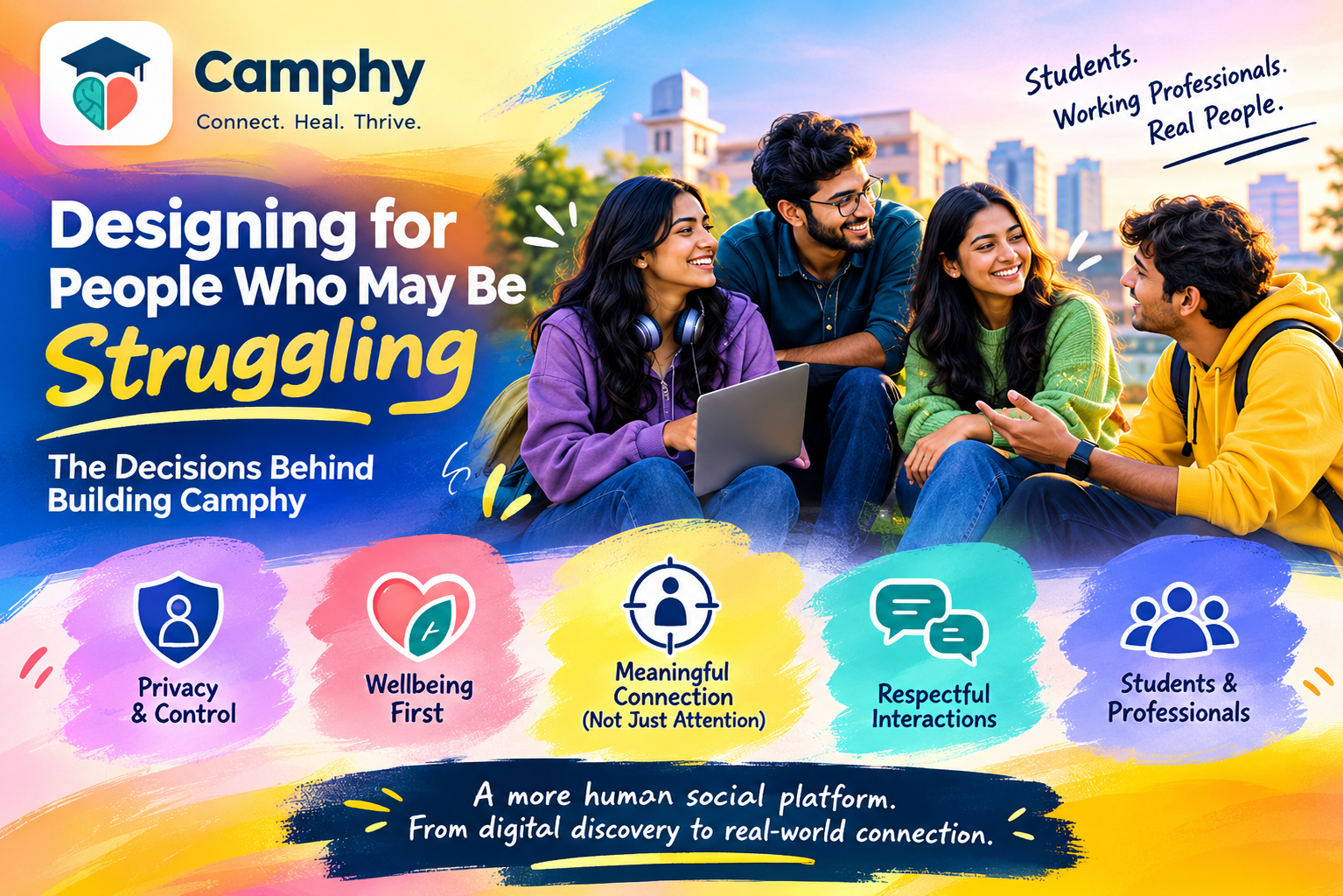
Designing for People Who May Be Struggling: The Decisions Behind Building Camphy
· Camphy
Why social product design is a human responsibility
A social platform can be designed to help people discover others, share interests and build communities. But behind every profile is a person with their own circumstances, expectations and vulnerabilities.
A student may be adjusting to university life, navigating academic pressure or trying to find their place in a new community. A working professional may have moved to a new city, started a demanding job or discovered that being surrounded by colleagues does not necessarily mean having a fulfilling social life.
Both may be looking for something simple: people they feel comfortable connecting with.
And both may arrive at a social platform on a difficult day.
Research highlights why this matters. The Healthy Minds Study's 2024-25 findings reported that 37% of surveyed college students experienced moderate to severe depressive symptoms, while 32% experienced moderate to severe anxiety symptoms. A separate 2026 analysis of college students found that 50.8% reported feeling lonely.
These findings concern student populations, but they raise a broader question for anyone building social technology: How should we design products for people whose circumstances and emotional needs we cannot fully see?
At Camphy, we believe this question deserves attention from the beginning, not after a product has grown.
We are building a social networking platform focused on helping students and working professionals discover like-minded people and create opportunities for face-to-face interaction.
We are not building a clinical mental health service, and we do not claim that an app can solve loneliness. Our focus is different: making it easier for people to find shared interests, participate in activities and develop meaningful relationships in the real world.
That distinction shapes how we think about product design.
The decisions behind building a more human social platform
Responsible product design is rarely about choosing between an obviously good option and an obviously bad one. Often, it involves balancing competing needs: convenience and privacy, discovery and control, engagement and wellbeing.
These are the questions we believe social platforms should take seriously.
1. Engagement versus meaningful connection
Many digital products measure success through attention: how often users return, how long they stay and how frequently they interact.
Those measures can be useful for understanding product usage. But they do not necessarily tell us whether people are forming meaningful relationships.
A user can spend considerable time scrolling without making a single real-world connection. Another user may open a platform briefly, find someone with a shared interest and arrange an activity that becomes a recurring part of their social life.
Which experience should a social connection product value more?
For Camphy, this is an important distinction.
We want technology to help people move from discovery to participation, rather than making time spent on the platform the ultimate objective.
That means asking different questions when evaluating product experiences:
- Does this feature help people discover relevant connections?
- Does it provide a natural reason to interact?
- Does it support opportunities for offline activities?
- Does it help people return to communities and shared experiences?
We believe engagement is most valuable when it serves a meaningful purpose.
The principle: Build for the quality and usefulness of connection, not attention alone.
2. Easy discovery versus user control
Finding people nearby can make social discovery more relevant. Shared interests, location and common activities can help people find others they might otherwise never meet.
But discovery also raises questions about privacy, visibility and personal boundaries.
A student may be comfortable meeting people within a campus community but not want their profile widely visible. A professional may want to find people for weekend activities without exposing unnecessary personal information.
The objective should be to make discovery useful without making users feel that they have surrendered control.
This is why privacy and transparency should be part of product design, rather than considerations added at the end.
Users should be able to understand what information they share, how it supports the experience and what choices they have.
For a social product, trust is not separate from usability. It is part of it.
The principle: Make it easier to discover people while respecting individual boundaries and informed choices.
3. Digital interaction versus real-world participation
Digital introductions are convenient. Real-world interactions, however, often require more context.
Two people may share an interest in fitness, entrepreneurship, music or food technology, but still hesitate to meet because they do not know how to begin.
A shared activity can reduce that uncertainty.
Instead of starting with an unfamiliar conversation, people can start with something they both want to do: play badminton, explore a new place, attend an event, work on a project or grab coffee.
This is central to how we think about Camphy.
Our approach, which we describe as Peer-to-Near, Face-to-Face, focuses on creating pathways from digital discovery to offline interaction.
The goal is not to assume that every introduction will become a friendship. It is to make the first step more natural and give people opportunities to interact around shared interests.
This matters for students looking to build campus communities and for professionals trying to establish a social circle in an unfamiliar city.
The principle: Use technology to reduce the friction of meeting people, not to replace the experience of meeting them.
4. What happens when a connection does not happen?
Social products often focus on successful interactions: a match, a reply, an invitation or a completed activity.
But unsuccessful interactions deserve attention too.
What happens when someone reaches out and receives no response? What happens when an activity does not attract participants? What happens when a user struggles to find people with similar interests?
For someone who is already uncertain about approaching others, an unsuccessful interaction can feel discouraging.
We should not assume that every unanswered message causes harm, or that a platform can prevent every uncomfortable experience. People have different expectations, and nobody is obligated to respond to every invitation.
But product design can still influence how these situations feel.
Clear expectations, respectful communication, useful alternatives and opportunities to try again can make the experience more constructive.
For example, a platform can help users understand that availability varies, suggest other relevant activities where appropriate, and avoid implying that a lack of response reflects their personal worth.
The important distinction is between acknowledging an unsuccessful interaction and treating it as a judgement of the person.
The principle: Design for ordinary human uncertainty, not just ideal user journeys.
5. Supporting wellbeing without pretending to provide clinical care
A social platform may encounter users who express distress, describe difficult experiences or seek support from other people.
That creates an important responsibility.
Social connection can be valuable, but a peer network is not a substitute for professional mental health care. Nor should a platform imply that its features can diagnose a person's condition or reliably determine what they need.
Responsible design requires clarity about these boundaries.
It also requires appropriate processes for reporting harmful content, addressing safety concerns and communicating available support resources.
Where content suggests an immediate risk, responses should be guided by a carefully designed safety process appropriate to the situation and the locations in which the product operates.
Such processes should account for both missed risks and false alarms. Automated systems, where used, should not be presented as infallible.
For Camphy, the broader principle is that technology should support human connection without making promises it cannot keep.
The principle: Take users' wellbeing seriously, communicate limitations honestly and distinguish peer connection from clinical care.
What these decisions mean for students and working professionals
Students and working professionals do not experience social life in exactly the same way.
For students, meaningful connection may involve finding friends on campus, discovering shared interests, joining activities or feeling more comfortable in a new environment.
For working professionals, it may involve building friendships after relocation, meeting people beyond the workplace, finding activity partners or developing a sense of community in a busy city.
Yet the underlying design challenge is similar.
People need opportunities to connect that fit their circumstances, respect their boundaries and give them a reason to participate.
This is why we do not believe a single feature or matching algorithm can address every social need.
A useful social product must consider context: where people are, what interests them, what they want to do and how comfortable they feel taking the first step.
It must also recognise that not everyone wants the same kind of connection at the same time.
Some people are looking for new friendships. Others want activity partners or communities built around shared interests. Some may simply want to explore what is happening around them.
Good design creates room for these different needs without assuming that every user is experiencing loneliness or requires intervention.
What responsible design means for us
Building Camphy has reinforced an important idea: product decisions are not only technical decisions. They also express what a company values.
A decision about visibility affects privacy. A decision about notifications affects attention. A decision about discovery affects who can find whom. A decision about how an unsuccessful interaction is presented can influence how a user experiences the platform.
No single design choice can guarantee a positive outcome. Research on social technology and wellbeing continues to evolve, and findings from one population or platform may not apply universally.
We therefore believe in approaching these questions with humility.
That means being clear about what a feature does and does not do, treating privacy and safety as ongoing responsibilities, listening to users and revisiting decisions when evidence or experience suggests a better approach.
It also means resisting the temptation to equate growth with impact.
A larger user base is not, by itself, evidence that people feel more connected. More interactions do not necessarily mean stronger relationships.
The more meaningful question is whether the product creates useful opportunities for people to participate, meet and develop relationships on their own terms.
That is the standard we want to keep working toward.
What we still need to learn
We do not have every answer.
We still need to understand which experiences make people more comfortable initiating contact, which activities help connections continue beyond a first meeting, and what makes a digital introduction genuinely useful in everyday life.
We also need to understand the people who choose not to use a social platform, or who try one and leave. Their reasons may reveal barriers that existing users cannot explain.
These questions deserve more than assumptions or marketing claims. They require listening, careful evaluation and a willingness to change direction when necessary.
We welcome perspectives from students, working professionals, researchers, community organisers and people working in social and mental wellbeing.
If you have experience building communities or studying how people form meaningful relationships, we would value your perspective.
Building technology that brings people closer
The internet has made it easier than ever to find information, discover communities and communicate across distances.
Yet finding people online does not automatically translate into feeling connected in everyday life.
We believe there is an opportunity to build technology that helps close that gap.
For a student, that might mean finding someone who shares an interest on campus. For a working professional, it might mean discovering an activity partner in a new city. For someone else, it might mean finding a community where showing up feels a little easier.
These are small beginnings, but meaningful relationships often develop through ordinary experiences repeated over time.
At Camphy, we want to help create more opportunities for those experiences to happen.
Not by promising to eliminate loneliness. Not by replacing professional support. And not by keeping people on a screen for longer than necessary.
But by making it easier to discover people, share interests and connect in the real world.
Because responsible social technology should do more than bring people online. It should help bring people closer.
Camphy - Connect. Heal. Thrive.
Visit www.camphy.in.
Sources
- University of Michigan School of Public Health, Healthy Minds Study 2024–25 findings: https://sph.umich.edu/news/2025posts/college-student-mental-health-third-consecutive-year-improvement.html
- Reeves-Doyle, Sanyaolu and Scott-Hillis Geller, Student Organization Involvement and Mental Health, Frontiers in Education, 2026: https://www.frontiersin.org/journals/education/articles/10.3389/feduc.2026.1847079/full
- U.S. Surgeon General, Social Media and Youth Mental Health Advisory, 2023: https://www.hhs.gov/sites/default/files/sg-youth-mental-health-social-media-advisory.pdf
- Suicide Prevention Resource Center, Safe and Effective Messaging and Reporting: https://sprc.org/keys-to-success/safe-and-effective-messaging-and-reporting/